My Credo grew out of The Credo Project, which Rabbi Cary Friedman and I developed during a week together in Austin, Texas. We began with a question: How do you hold to your highest aspirations when the pressures of life seem to conspire to drag you beneath them?
Cary has spent more than three decades thinking about that question. He addresses it in his books Spiritual Survival for Law Enforcement, Wisdom from the Batcave, and The Superhero Handbook for Cops.
I first saw Cary in the extras on The Dark Knight Blu-ray, discussing the deeper spiritual meaning of the Caped Crusader. He saw in The Batman something familiar to many law enforcement officers: a desire to live up to the ideals of the heroes they admired in their youth.
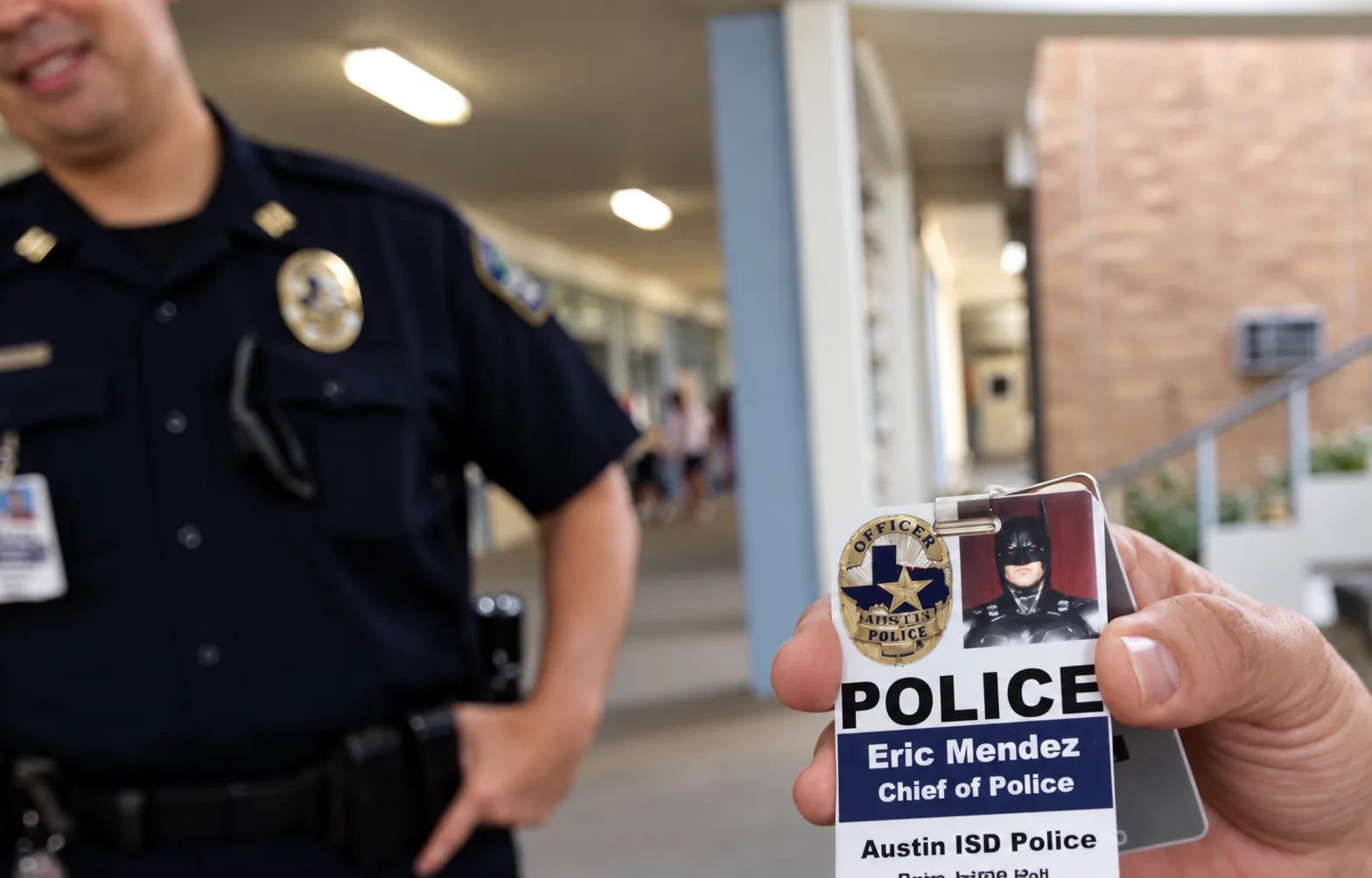
When we met in Austin to turn that idea into a program, the officers we interviewed gave the project names and faces. For DPS pilot Ed Burris, the hero was John Wayne. For Constable Adan Ballesteros, it was Steve McGarrett. For Austin ISD Police Chief Eric Mendez, it was The Batman — and he had his ID to prove it.
Chief Mendez holds up his ID card, with a picture of The Batman taped over his own photograph.
Cary's theory of the case was right. It was a bit astonishing.
The question was: How could we give today's officers that same sense of direction and fortitude, especially when the heroes they grew up with offered a more complicated standard to follow?
The Credo Project emerged from those conversations. My Credo carries that work forward, providing a powerful yet simple way to orient your life.
We hope this project helps you keep your North Star in sight. If it does, you'll quickly discover that while you look to Polaris, others will be looking to you.
"Write it plainly. Write it clean. Write it so a child can understand it and a grown man cannot wriggle out of it."
The Credo Project
Write the words you intend to live by.
Open the book to begin. In about an hour, you will have a sentence — written in your own hand — that names what you stand for clearly enough that it changes what you do. No accounts. Nothing to join. Just you and a scrap of paper.
A guide to closing the gap between who you intend to be — and who you actually are under pressure.
You know the kind of person you want to be. You can feel it. You could probably describe it to someone in a quiet moment over coffee.
But that is not always the person who shows up.
There is a gap — and you have felt it. The moment after a shift when you replay how you handled something and think, that wasn't me. The slow erosion when fatigue, cynicism, or a bad week pushes you toward a version of yourself you did not sign up to become. The distance between your intentions and your behavior on the days it actually costs you something to be good.
Everyone has this gap. The question is whether you have a tool to close it.
That tool is a credo: a single sentence, written in your own words, that names what you stand for clearly enough that it changes what you do. Not a slogan. Not a mission statement. Something smaller than that. And heavier. Something that talks back to you on a bad night.
This will take about an hour. By the end, you will have that sentence — written in your own hand, in your own words. There are no accounts here. No forms. Nothing to join. When you are done, you will have a scrap of paper with your handwriting on it, and that will be the whole thing.
Chapter One
What a Credo Is
There is a pretty good chance you ride around all day with one printed on your vehicle:
"To Protect and to Serve."— Officer Joseph S. Dorobek, LAPD Winning entry in the Police Academy's 1955 motto contest
Officer Dorobek was onto something. Four words. Short, memorable, actionable. They became the LAPD's official motto and now appear on law-enforcement vehicles across the country.
The word credo comes from Latin — credere, "I believe." The original root means, literally, "to put one's heart." The same root gives us credit (something you trust) and creed (something you confess). When you write a credo, you are putting your heart somewhere on purpose, where you can find it again when you need it.
Law enforcement gives its guiding words different names: mottos, core values, pledges. The FBI's "Fidelity, Bravery, Integrity." The Coast Guard's Semper Paratus — "Always Ready." The California Highway Patrol's "Stand for what is right despite the threat of adversity." These words gave every new officer a clear standard: This is who we are. This is what we expect of you.
But here is the catch: those are group words. They tell the organization what it stands for. They do not tell you what to do at 2 a.m. when you are tired, angry, carrying power over someone else, and nobody is watching.
That is the gap. The institution gave you a motto. It did not give you a personal standard for the moments that actually test you. A personal credo fills that space. It names — in your own words — how you intend to behave when it would be easier not to.
Chapter Two
Picture This
You are a thirty-five-year veteran of the police force.
You have done the job. You have worn the uniform through long nights, bad calls, false alarms, family fights, death notifications, traffic stops, courthouse hallways, hospital rooms, and quiet moments no one else will ever know about.
You are respected in the department. Trusted in the community. You have made mistakes. You have learned from them. You have carried things that did not show on your face.
Sitting next to you in the squad car is a young officer. A rookie. In a sense, this officer is going to take your place.
For a moment, time seems to stop.
The young officer knows this is a moment. He knows he should say something. He has no idea what.
Finally, you turn toward him. You look at him the way only a veteran officer can look at a rookie.
You say:
"You're ready. You've been through the academy. You know the law. You know procedure. You know how to write the report, clear the call, make the stop, read the room, and call for backup.
Just remember this.
Always…"
Freeze the frame. What comes next?
Whatever you are about to say is not a motto, slogan, or mission statement. It is not something printed on a challenge coin or painted on the wall of a briefing room.
It is something smaller than that. And heavier.
It is your personal credo.
Chapter Three
This Is Older Than You Think
If the word "credo" sounds soft to you, consider who has kept one.
Every warrior culture that ever lasted wrote its code down and made its people memorize it. The samurai had bushido. The knights had their code of chivalry. The cowboy had the Code of the West — unwritten, but every man on the range could recite it: never shoot first, never take unfair advantage, never go back on your word, help anyone in distress.
The modern military never stopped. Every soldier in the U.S. Army learns the Soldier's Creed: I will always place the mission first. I will never accept defeat. I will never quit. I will never leave a fallen comrade. Rangers memorize the Ranger Creed. The Green Berets wear a Latin motto on their patch — De Oppresso Liber, "to free the oppressed" — because a sentence can hold a man together when nothing else will.
Notice what those sentences have in common. They are short. They are first person. They are about behavior, not feelings. Nobody would call the Ranger Creed wishy-washy.
"You don't embarrass the Rangers."— Legendary Texas Ranger Bobby Grubb
Sailors navigate by the North Star not because it is the brightest star in the sky, but because it does not move.
That is what you are about to build.
Chapter Four
The Account That Needs Deposits
A note before you read this chapter. The word "spiritual" here does not mean religious. You can be entirely secular and take every word seriously.
What "spiritual" means here is the part of you that decides what your work is for — the part that knew, the first time you put on the uniform, that you were doing something that mattered. Every officer has that part. Nobody gets to the academy without it. That part needs maintenance like everything else on your kit — and it is the one piece of equipment nobody ever trained you to maintain.
Every police officer enters the academy with a full account — a set of values, beliefs, and reasons for doing this work. Over time, the job can drain that account. Calls pile up. Cynicism grows. The original convictions become harder to find.
My Credo exists to stop that from happening.— Rabbi Cary Friedman, police chaplain and FBI spirituality consultant
Rabbi Friedman says the career carries three kinds of danger.
Physical dangers. Most of your training has been about these. They are real, and the training is good.
Emotional dangers. The trauma of what you see. The strain on the family. The grind of shift work and the slow accumulation of cases that will not let go. Most departments now acknowledge these, even if the support is uneven.
Spiritual dangers — the slow erosion of the part of you that decided, once, that this work was worth doing. Friedman puts it bluntly: "More officers end their careers because of the spiritual dangers than due to any other reason."
He calls the long version of this spiritual overdraft. When officers spend down what brought them into the career — the idealism, the sense of calling, the belief that what they do matters — without ever depositing anything back, they go into deficit.
You have already seen this happen. The officer who used to care and stopped. The retirement that was supposed to be a reward and turned into a collapse. Nobody trained for those calls, because nobody taught the maintenance.
A credo will not, by itself, prevent any of this. It is not a substitute for clinical care, for a department that takes wellness seriously, or for a chaplain you can talk to. Anyone who tells you a sentence will fix everything is selling something.
What it does is give you a place to put your feet. A short sentence, written by you, that names what you are still here for. On a hard day, you can return to it. Over a long career, you can read it back and notice when you have drifted.
In Friedman's framing, the credo is a deposit into the spiritual account. Small. Repeatable. Yours.
Chapter Five
Anatomy of a Good Credo
A credo has five properties. If yours is missing one, you can usually feel it — the sentence lands soft.
1It is personal.
I will. I believe. I refuse to. Not "officers should." Not "as a department, we." This is not policy language. This is yours.
2It is short.
A sentence or two. No more. If you cannot remember it on a hard Tuesday near the end of a long shift, when you are tired and the call is going sideways, it is not ready yet. Cut it down. Then cut it again.
3It is actionable.
A credo names something you do, or something you refuse to do. It tells you what to do at 2 a.m., not how to be in general.
4It is honest.
Not an idealized version of you that no one who knows you would recognize. It is you at your best. The real you. The one who first wanted to do this work before the job got rough.
5It is ridiculously specific to you.
It is tied to your life, your habits, your daily triggers — the corner you turn on the way home, the moment you start your car, the sound of your child's voice asking a question.
Vague vs. Real
Specific words have power. Vague words drift away.
Vague
Better
I will serve with honor.
I will tell the truth, even when it costs me.
I will help people.
I will look for the person inside the problem.
I will be brave.
I will stay calm when others cannot.
I will strive for excellence.
On this shift, I will speak to every person as if my words may be the only dignity they receive today.
The Tuesday Morning Test
Read the sentence to yourself on a Tuesday morning, before coffee, when nothing dramatic is happening. Does it still feel true? Does it still feel like yours? Does it tell you anything about how to handle the next eight hours? If yes — that is the one.
Chapter Six
The Corner of Maple and Elm
Here is what a credo looks like when it is finished.
A working officer wrote this. It is published here with his permission:
Every day, on my way home from my shift, at the corner of Maple and Elm — the last stop sign before home — I pause for a moment and think:
"Okay, get out. All of you. The damaged, the irresponsible, the crude, the careless. Out. You're not coming home with me. Hit the curb. Department politics, every rotten thought — today's accumulation of negative vibes — all of it gets left at the curb.
I will turn the corner as a husband and a father. I will not let that be taken from me."
Notice what makes it work.
It is tied to a specific place — a real intersection he drives through every day. It is tied to a specific action — pausing at the stop sign. It is tied to a specific identity — husband and father. And it names what he refuses — to carry the worst of the shift across that threshold.
Write it on a piece of paper and just try to forget it. You will not.
And when he reads it thirty years from now, he will not have to try to remember what it meant — because he will have lived it every day since.
That is a credo.
Chapter Seven
A Scrap of Paper
Before you finish this page, you will write a sentence — maybe two — on a scrap of paper. You will write it in your own hand.
That piece of paper will outlast the shift, the badge, the uniform, the stories, the commendations, and the job itself.
Your children will cherish it. They will hang it on the wall. They will show it to their children. They will say, "This is what he lived by."
A scrap of paper. A few words. Your handwriting.
That is why it gathers weight. Because it carries the one thing no certificate, photograph, citation, or retirement plaque can carry. It says what ruled you from the inside. It says what you did when nobody was keeping score.
Write it plainly. Write it clean. Write it so a child can understand it and a grown man cannot wriggle out of it. No fog. No ceremony. No borrowed words. Say what you live by. Say what you do. Say what you refuse to become.
Chapter Eight
Before You Write
Do not start by trying to sound wise. Start by remembering who you are at your best.
Your credo already exists. You have lived pieces of it. The work now is to find the words.
Take a few minutes with these. You do not have to answer all of them — just the ones that feel true. Nothing you type here is saved or sent anywhere.
Chapter Nine
Build the Sentence
Now reduce it. A credo works best when it is simple enough to remember. Try beginning with one of these starters — or ignore them all and write from scratch.
Tap a starter or just start writing
Chapter Ten
Test It
A credo should hold up under pressure. Read yours back and run it against these:
✓Could I remember this during a hard shift?
✓Does this sound like me — not like a poster?
✓Is it specific enough to guide what I actually do?
✓Would it help me when I am angry, tired, afraid, or discouraged?
✓Does it call me upward without pretending I am perfect?
✓Would the people who know me best recognize this as mine?
If the answer to any of these is no, simplify it. Go back to the builder. Cut a word. Replace a vague verb with a specific one. Make it shorter. Make it truer.
Most of the work of writing a credo is the cutting. That part will feel familiar. It is how reports get good.
Now Write It Down
On paper. In your own hand. Sign it. Date it.
A thought can drift. A written sentence waits for you.
Once your credo is written down, it becomes something you can return to, revise, carry, memorize, and live against.
Stand by your credo, and while you look to the Northern Star, others will be looking to you.
Conceived by Rabbi Cary Friedman — police chaplain, author of Spiritual Survival for Law Enforcement, and spirituality consultant to the FBI's Behavioral Science Unit — and Phillip LeConte, Executive Director of ChaplainUSA.