
America Has a Police Shortage. The Officers We Have Are Paying the Price.
What if one of the reasons American policing is so difficult, so stressful, and sometimes so confrontational is that we’re asking too few officers to do too much?
In an October 18, 2026, article for The Atlantic, writer Malcolm Gladwell raises a question that ought to concern every police chief, every city council member, and every police chaplain in America: What if our police departments are simply too small?
His article, America Has a Police Shortage, begins with a startling comparison.
Los Angeles has approximately 3.9 million residents and about 8,500 police officers. Berlin, with a comparable population, has roughly 18,000.
That’s more than twice as many officers serving roughly the same number of people.
Gladwell offers other comparisons. Phoenix has about 2,500 officers, while Munich, a city of comparable population, has nearly two and a half times as many. In Aurora, Colorado, a city of more than 400,000 residents, former police chief Daniel Oates managed a department of approximately 650 officers. Zurich, Switzerland, a city of similar size, had about 1,700.
Those comparisons have limitations. European and American police agencies have different jurisdictions, responsibilities, and organizational structures. Nevertheless, the differences are large enough to raise an uncomfortable possibility.
We have spent years arguing about the conduct of American police officers while paying considerably less attention to the conditions under which we ask them to work.1
What happens when there aren’t enough officers?
Imagine an officer beginning a night shift with a growing list of calls already waiting.
A domestic disturbance. A suicidal teenager. An intoxicated driver. A frightened elderly resident who believes somebody is trying to break into her home.
Each call demands something different. Each person deserves an officer capable of listening, evaluating the situation, exercising restraint, and making a sound decision.
But the calls keep coming.
There is another citizen waiting, another dispatcher asking for an estimated arrival, another report that needs to be written. A lunch break disappears. Backup may be farther away than anyone would like.
By the end of the shift, the officer may have spent hours moving from one person’s worst moment to another, without much opportunity to recover between them.
Now imagine that experience repeated, week after week.
The officer still has the same legal obligations. The same ethical responsibilities. The same expectation of professionalism.
But considerably less room to make a mistake.
Gladwell interviews former Aurora chief Daniel Oates and asks what he would do with hundreds of additional officers. Oates describes filling patrol gaps, reducing response times, and rebuilding community policing.
The most interesting part of his answer concerns all the problems officers might prevent if they had enough time to become familiar with the people and neighborhoods they serve.
An officer who knows a neighborhood may recognize a brewing conflict before somebody gets hurt. An officer with time to talk can sometimes settle a dispute without making an arrest. Familiarity creates opportunities for trust, early intervention, and better judgment.
Those are precisely the kinds of encounters that rarely make the evening news.
And they are among the most valuable things a police officer does.
The statistics suggest a genuine problem
There is substantial evidence that staffing pressures are real, even as some departments have begun to recover.
The Bureau of Justice Statistics reported that 46 percent of American local police departments employed fewer than 10 full-time-equivalent sworn officers in 2020. These small departments can face especially difficult coverage problems when an officer is sick, injured, attending training, or away on leave.
The Police Executive Research Forum, which has surveyed law enforcement agencies annually, found that staffing among responding departments declined 4.8 percent between January 2020 and January 2023.
Its May 2026 report offers some encouraging news: staffing increased 1.4 percent during 2025, and hiring rose 17.6 percent over 2024. Nevertheless, overall staffing remained below its early-2020 level. Retirements also increased 16.4 percent in 2025.
The crisis may be easing in some departments, but the recovery is incomplete.2
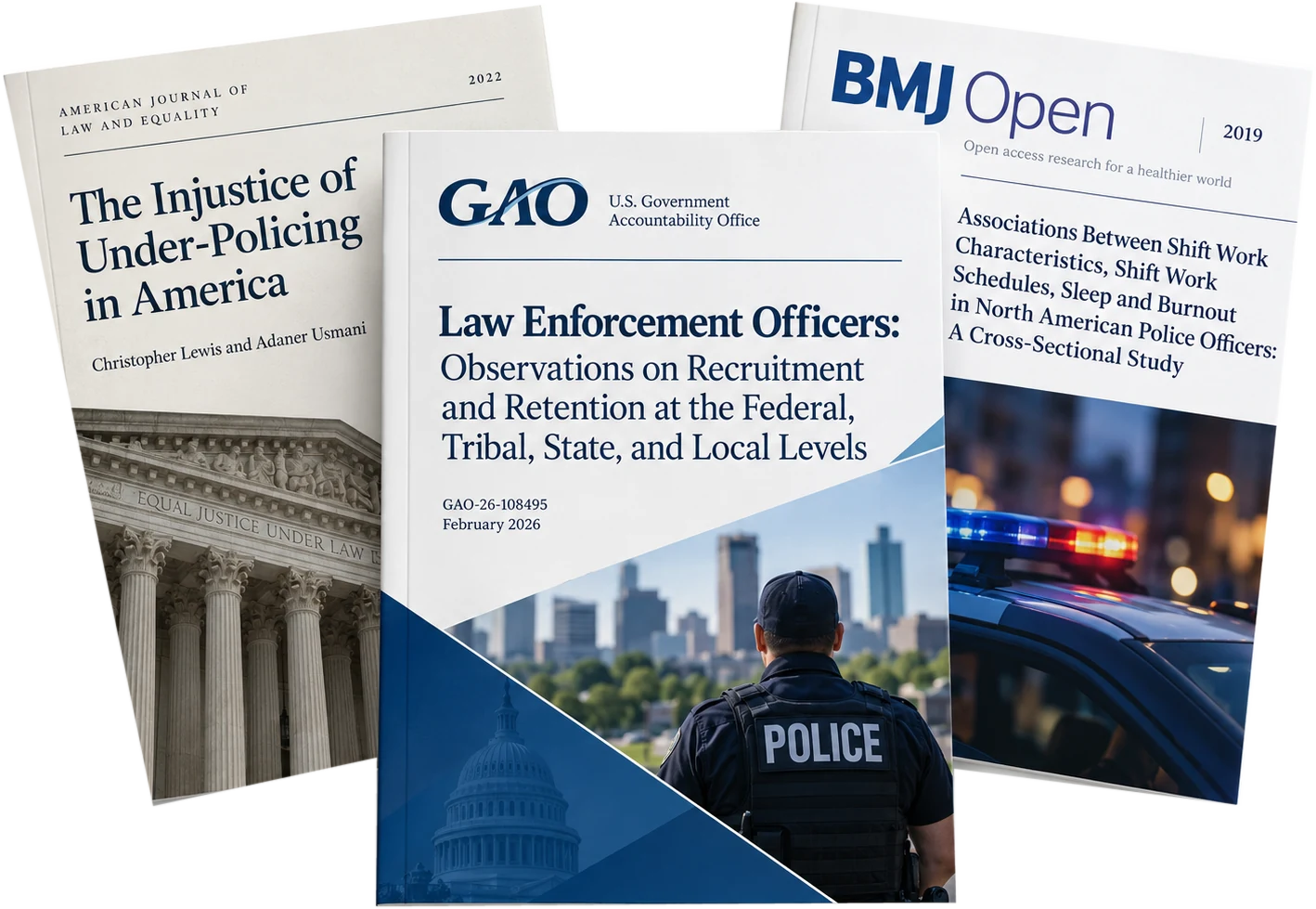
A February 2026 report from the U.S. Government Accountability Office reached a similar conclusion: recruitment and retention difficulties have contributed to staffing declines across federal, tribal, state, and local law enforcement agencies.4
More police officers may also mean less aggressive policing
One of Gladwell’s most provocative arguments is that police scarcity may contribute to the very behavior that critics of American law enforcement want to eliminate.
He draws on a 2022 study by Christopher Lewis and Adaner Usmani, The Injustice of Under-Policing in America.
Their research challenges the familiar idea that American criminal justice is defined simply by an excess of police. Compared with other developed countries, the United States relies much more heavily on incarceration relative to the size of its police force.
The researchers found that America had roughly three incarcerated people for every police officer. Across the developed countries they examined, the relationship was approximately reversed: about three and a half police officers for every incarcerated person.
Their argument deserves serious attention. A system that invests in capable, accessible policing may be better positioned to prevent crime and intervene early, rather than relying so heavily on punishment after the damage is done.3
There are important qualifications. Differences in firearm prevalence, violent crime, training, accountability, social services, and criminal justice systems also influence police behavior. International comparisons alone cannot establish that adding officers will reduce police violence.
Still, the underlying proposition is worth examining: A police officer with enough time, backup, training, and community trust may have more opportunities to resolve an encounter peacefully.
And that brings us to the people who work most closely with officers when the cumulative pressures of the job begin to show.
What this means for police chaplains
Police chaplains encounter aspects of the profession that rarely appear in staffing reports or city budget hearings.
They hear about the exhaustion that follows a difficult shift. The officer who feels guilty about losing patience with a citizen. The marriage strained by overtime. The veteran who no longer believes the department is capable of changing.
They also recognize that not all of an officer’s distress begins with a catastrophic event.
Sometimes it begins with the ordinary, relentless accumulation of responsibility.
An officer can endure a terrible call, recover, and continue a healthy career. But repeated exposure to distress, combined with inadequate rest, weak supervisory support, and little opportunity to process what has happened, can place a different kind of burden on a person.
We should be careful about drawing a straight line between understaffing and any particular mental-health outcome. Officer distress has many causes, and these staffing studies do not establish that shortages directly cause PTSD, depression, or suicide.
Nevertheless, they identify organizational pressures that deserve a place in every conversation about officer wellness.
For police chaplains, that suggests an important responsibility: when an officer begins to struggle, pay attention to the conditions surrounding that struggle.
How many consecutive shifts has the officer worked? How much overtime is being demanded? When was the last uninterrupted day off? Does the officer have adequate backup? Does the supervisor recognize the strain? Is the department asking a small group of people to absorb an unreasonable amount of suffering?
These questions should accompany our concern for an officer’s personal resilience.
A chaplain may offer a sympathetic ear, a confidential conversation within applicable limits, help finding professional care, or simply a steady presence after a difficult call.
But even the most dedicated chaplain cannot give an exhausted officer eight hours of sleep, restore a canceled day off, or put another squad car on the street.
There are limits to what individual caregivers can repair when the problem is built into the organization.
The cost of exhaustion is measurable
There is additional research that connects the demands of police work to officer wellness.
A 2019 study of North American police officers, available through the CDC’s National Institute for Occupational Safety and Health, examined work schedules, sleep, and burnout.
Researchers found that officers who frequently worked shifts of 11 hours or longer had approximately 91 percent higher odds of emotional exhaustion than officers who did not work those long shifts. Mandatory overtime was associated with 37 percent higher odds of emotional exhaustion.
Officers sleeping fewer than six hours also had substantially higher odds of emotional exhaustion. These were statistical associations, rather than proof of cause and effect, but the findings are difficult to ignore.5
Another CDC analysis found that poor sleep quality was 70 percent more prevalent among night-shift officers than among officers working days.6
For a profession that regularly requires split-second judgments under uncertain and potentially dangerous circumstances, these findings should command attention.
We train officers extensively in firearms, defensive tactics, emergency driving, and legal procedure. We expect them to demonstrate exceptional judgment when angry, frightened, or exhausted.
Yet the research suggests that scheduling and workload can erode some of the very capacities that good policing depends upon.
A different conversation about officer wellness
The implications extend beyond hiring.
Police departments should examine whether their staffing and scheduling practices give officers a reasonable opportunity to remain healthy, attentive, and effective. City governments should consider the relationship between police staffing, response times, community relationships, and the workload carried by individual officers.
Police chaplains can help make those conversations more informed.
When officers describe persistent exhaustion, increasing irritability, withdrawal from their families, or growing cynicism about the profession, chaplains should consider whether organizational conditions are contributing to the problem.
They can also bring these concerns to command staff in appropriate ways, respecting individual confidentiality while drawing attention to recurring patterns.
Better staffing will not solve every problem in American policing. Training, supervision, accountability, sound judgment, and community trust remain essential. Other public services, including mental-health crisis teams, can also reduce the demand placed on patrol officers.
But Gladwell’s article raises a question that deserves a place in the national conversation.
Perhaps we should spend less time asking how much more our police officers can endure and considerably more time asking what we can reasonably expect from the number of officers we employ.
Police chaplains have long understood that officers cannot carry every burden indefinitely.
The evidence now gives us additional reasons to take that concern seriously.
If we want patient, thoughtful, restrained police officers, we need to pay attention to the working conditions that make patience, thoughtfulness, and restraint possible.
And if we expect officers to be there when we need them, we should make certain there are enough of them to do the job.
Research and further reading
Sources consulted for this ChaplainUSA article, with original research prioritized where available.
- Malcolm Gladwell, “America Has a Police Shortage” — The Atlantic, October 18, 2026. The article that prompted this discussion.
- Police Executive Research Forum, 2026 Staffing Survey — May 23, 2026. National survey of hiring, resignations, retirements, and staffing recovery among participating agencies.
- Christopher Lewis and Adaner Usmani, “The Injustice of Under-Policing in America” — American Journal of Law and Equality, 2022. Research examining the balance between police capacity and incarceration internationally.
- U.S. Government Accountability Office, Law Enforcement Recruitment and Retention — February 3, 2026. Federal assessment of staffing pressures and recruitment challenges.
- Associations Between Shift Work Characteristics, Sleep and Burnout in North American Police Officers — 2019. Research examining scheduling, overtime, sleep, and emotional exhaustion.
- CDC/NIOSH: Shiftwork May Lead to Health Problems Among Police Officers — 2022. Research-based summary of sleep quality, injuries, and shift-related health risks.