
Police officers are trained to recognize when someone needs help. They learn to read the warning signs, assess the danger, and take action. But recognizing those same warning signs in themselves can be considerably more difficult.
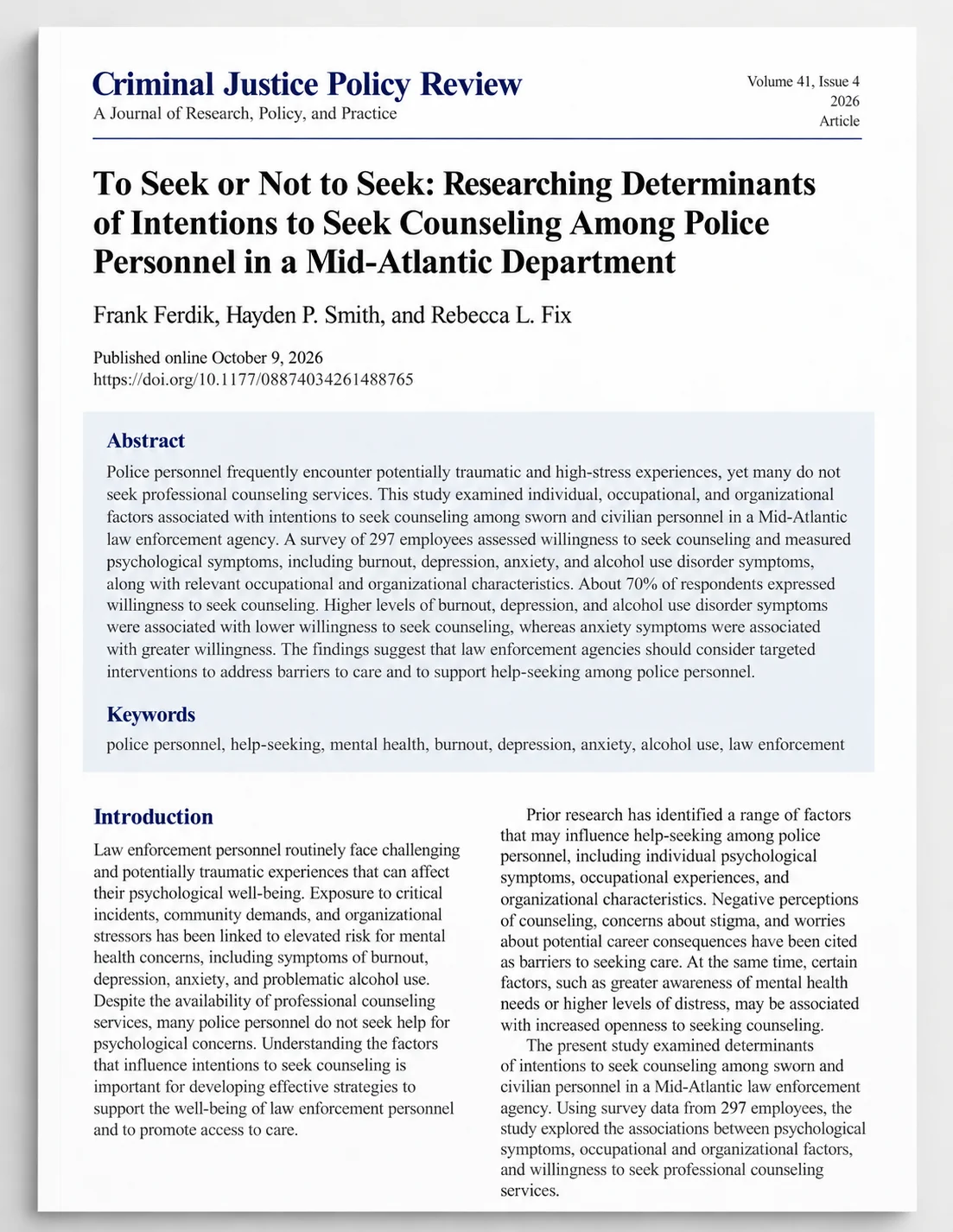
A new study published October 9, 2026, in Criminal Justice Policy Review raises a troubling possibility: some police personnel experiencing symptoms of depression, burnout, or alcohol use disorder may be less willing to seek counseling precisely when they could benefit from professional support.
Researchers Frank Ferdik, Hayden P. Smith, and Rebecca L. Fix surveyed 297 sworn and civilian police personnel in a Mid-Atlantic law enforcement agency. Approximately 70 percent expressed a willingness to seek counseling.
That sounds encouraging. But a closer examination revealed something important.
Personnel reporting greater symptoms of burnout, depression, and alcohol use disorder were less likely to express willingness to seek counseling. Those reporting anxiety symptoms, by contrast, showed greater willingness.
The researchers did not establish why these differences exist. But the findings raise a serious question for those responsible for officer wellness: What happens when the people who need assistance are also the people least inclined to ask for it?
The Distance Between Needing Help and Seeking It
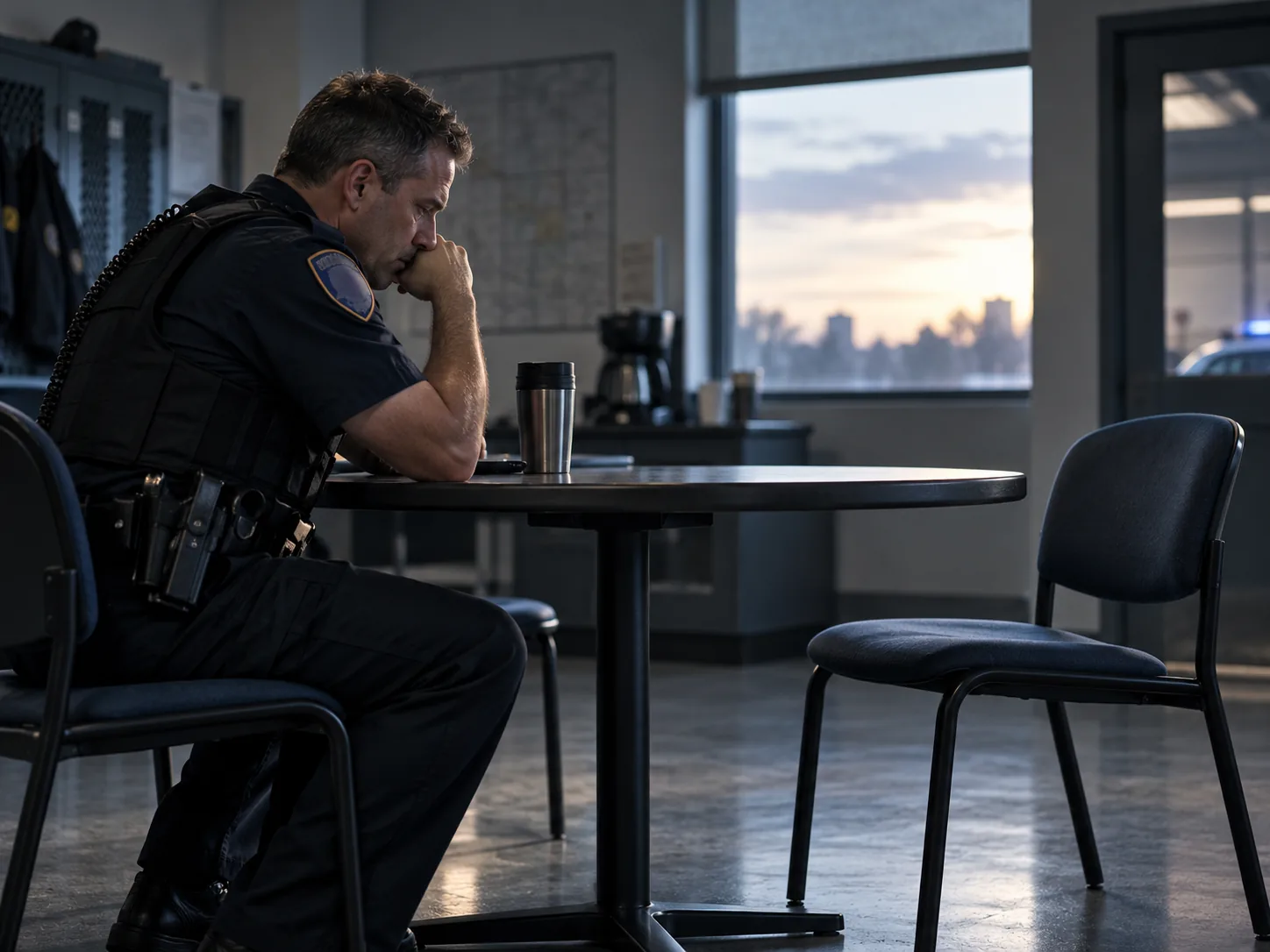
Police culture places considerable value on self-reliance. An officer is expected to remain composed in situations that would overwhelm most people, make decisions under pressure, and carry on when the call is over.
Those qualities are essential to the profession. But the expectation of composure can become a liability when an officer begins to struggle.
Depression may bring withdrawal, hopelessness, or a loss of motivation. Burnout may leave an officer emotionally exhausted and increasingly detached from colleagues and family. Problematic alcohol use can complicate both conditions.
These symptoms may interfere with the very initiative required to seek help. That is one possible explanation for the associations reported by Ferdik and his colleagues, although their study did not test that explanation.
Earlier research has identified other obstacles.
A 2020 study published in JAMA Network Open examined mental health and treatment-seeking among officers in a large Texas police department. Researchers identified several barriers, including concerns about confidentiality, fear of being judged unfit for duty, difficulty recognizing one’s own psychological distress, and doubts that mental health professionals would understand police work.
In that study, only 19 of the 114 officers screening positive for current mental health symptoms had sought mental health services during the preceding 12 months.
The distinction between recognizing a problem, wanting help, and actually receiving care is significant.
An officer may understand that counseling is available and still have compelling reasons, at least in his or her own mind, to stay away.
Where Police Chaplains Come In
Police chaplains occupy an unusual position within law enforcement.
They are familiar with the department, its people, its pressures, and its culture. Yet their work is fundamentally relational. Much of it takes place outside the formal structures of command, discipline, and performance evaluation.
A chaplain may encounter an officer during a shift, in a hallway, after a difficult call, or at a funeral. Sometimes the conversation concerns something entirely ordinary.
Those everyday encounters create opportunities to establish trust long before a crisis develops.
For an officer who is reluctant to seek counseling, an established relationship may make an initial conversation easier. There may be no appointment to schedule, no clinical terminology to navigate, and no immediate expectation that the officer must explain everything that is wrong.
The chaplain can listen, recognize when additional help may be needed, and assist the officer in reaching an appropriate professional.
That possibility is consistent with the researchers’ recommendation to consider targeted interventions, including peer support. It is also consistent with guidance from the International Association of Chiefs of Police, which identifies chaplains as resources who complement an agency’s behavioral health and peer-support programs.
The distinction is important. Chaplains are not substitutes for licensed mental health professionals. Their value may lie in recognizing distress, sustaining human connection, and helping an officer take the next step toward appropriate care.
Trust Requires More Than Good Intentions
An officer who fears that a conversation might jeopardize a career has a practical concern that cannot be dismissed with reassurance alone.
Confidentiality protections vary according to state law, the status of the person providing support, departmental policy, and the circumstances of a disclosure.
A chaplain should therefore be able to explain clearly what is confidential, what is privileged, and what circumstances require disclosure or intervention.
Promises of absolute confidentiality, where such protection cannot be guaranteed, can undermine the very trust a chaplain hopes to establish.
The Department of Justice has identified confidentiality as a central concern in police wellness and peer-support programs. That concern deserves equal attention from departments that rely upon chaplains.
An officer needs to know what will happen to the information shared and how the chaplain can help when professional treatment becomes necessary.
The Importance of Being There Before the Crisis
There is another implication worth considering.
Police wellness programs often receive their greatest attention after a shooting, a line-of-duty death, a suicide, or another traumatic event. These moments require a serious and coordinated response.
But depression, burnout, and problematic drinking do not necessarily begin with a single catastrophic incident. They may develop over time, amid difficult schedules, strained relationships, accumulated disappointments, and the ordinary pressures of police work.
A police chaplain who is known only as someone who appears after a tragedy may have fewer opportunities to build relationships with officers who are gradually withdrawing.
Regular presence offers something different.
It allows an officer to know the chaplain as a person before having to approach that chaplain with a problem. Trust can develop through conversations that carry no particular urgency.
When distress eventually emerges, the relationship may already exist.
This is a practical implication of the research, rather than an outcome demonstrated by the Ferdik study. We still need stronger evidence about which chaplaincy practices most effectively encourage officers to obtain professional care.
Nevertheless, the distinction between emergency response and sustained availability deserves attention in every department’s approach to officer wellness.
What the Research Can—and Cannot—Tell Us
The study offers useful evidence, but its limitations are important.
The researchers surveyed 297 sworn and civilian employees from a single department. Their findings should not be assumed to represent all police officers or agencies.
They measured respondents’ reported willingness to seek counseling, rather than whether those individuals subsequently sought or received treatment.
The associations also cannot establish cause and effect. The study does not demonstrate that depression or burnout directly causes reluctance to seek help.
Nor does it evaluate whether police chaplains or peer-support programs improve counseling participation.
What it does establish is an association worth investigating: different forms of psychological distress may be accompanied by different attitudes toward seeking professional assistance.
That finding should influence how departments think about access to care, even as researchers work to understand the underlying reasons.
The Officer Who Never Asks
Every police chaplain understands the importance of responding when an officer reaches out.
But this research directs attention toward another officer: the one who has stopped reaching out.
Perhaps that officer has become withdrawn. Perhaps the familiar conversation in the squad room has disappeared. Perhaps colleagues have noticed changes without knowing what to make of them.
None of those observations, by themselves, establishes that an officer is experiencing a mental health condition. But they may provide a reason for someone who knows and cares about the officer to make contact.
There is considerable wisdom in that ordinary act of showing up.
Police chaplains cannot make every officer accept help. They cannot diagnose every difficulty or solve every problem. They can, however, develop relationships that make it easier for someone to speak before circumstances become desperate.
Ferdik, Smith, and Fix have identified an important gap between psychological distress and willingness to seek counseling.
For police chaplains, the challenge is to consider what can be done within that gap—and how a trusted relationship might help an officer cross it.