
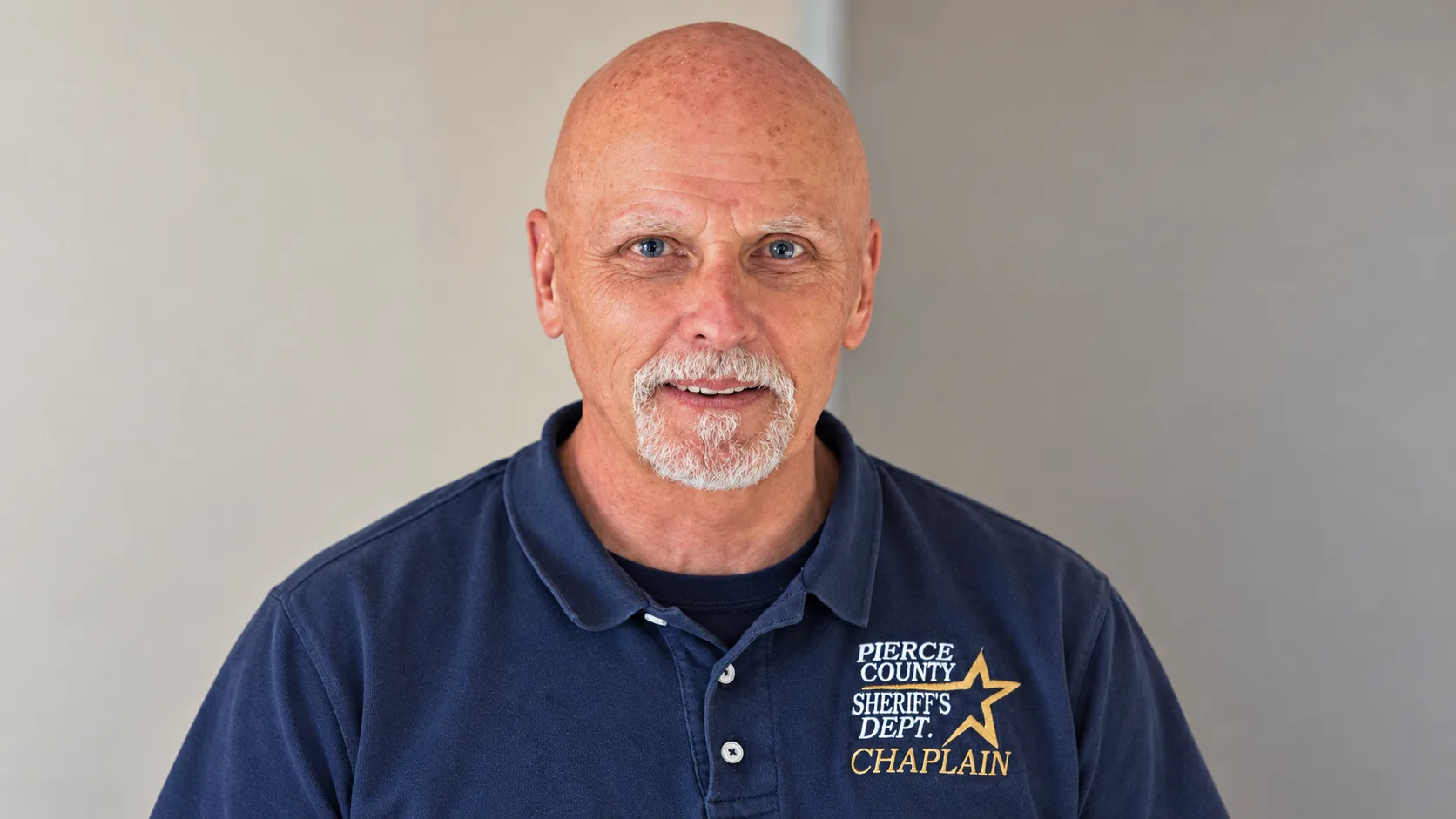
Rick Bulman
Pierce County Sheriff’s Office chaplain · Critical-incident care
Rick Bulman served as a chaplain with the Pierce County Sheriff’s Office in Washington. He offered an opening prayer before the Washington State House of Representatives and was photographed supporting people at the scene of the 2009 Graham, Washington, murder-suicide in which five children and their father died. Those public moments fit the quieter work he describes: staying present where violence has left people shocked and disoriented.
Bulman carries a memorial bracelet bearing the names of Washington officers killed in 2009: four Lakewood officers, another officer and a Pierce County sheriff’s deputy he knew. The bracelet is a visible record of losses that also shape his approach to traumatic scenes.
He describes the effect of horror as something like silt settling inside a person. His way of keeping it from hardening is to talk—usually with fellow chaplains, officers and other trusted people—and to let them see how an experience affected him. “It’s extremely important for chaplains and law enforcement officers to be transparent.” Verbalizing fear, grief or shock removes some of its control.
“I sense that it’s extremely important for chaplains and law enforcement officers to be transparent. And with that comes being vulnerable, which is not something that law enforcement officers like to do.”
He is equally direct about critical-incident debriefing. Professional guidance calls for it within 72 hours, and Bulman has seen why. A good debriefing gives participants a structured place to speak about the same event, compare what they experienced and release pressure before silence turns it inward. He remembers watching men physically exhale at the end of those conversations.
“I’ve seen men have a sigh of relief once they complete the debriefing [following a critical incident]. It really is helpful and effective, because it’s a place where you come to talk together about the event and experience. It lets you release the pressure.”
His ability to recognize post-traumatic stress comes partly from his own experience after Vietnam—an experience he avoided examining for years because he did not believe it had affected him. Experience, in his account, does not make a chaplain invulnerable. It makes honest processing more urgent.
In his Police Chaplain Project interview On Processing Horrific Scenes , Bulman discusses cumulative trauma, critical-incident debriefing, his delayed recognition of post-traumatic stress after Vietnam, and why a chaplain’s own vulnerability can give officers permission to speak.
Bulman’s service rests on a hard-won idea: what is carried in silence grows heavier. By naming what war, violence and loss leave behind, he made room for officers and chaplains to breathe again—and showed that vulnerability can be one of a responder’s forms of courage.