
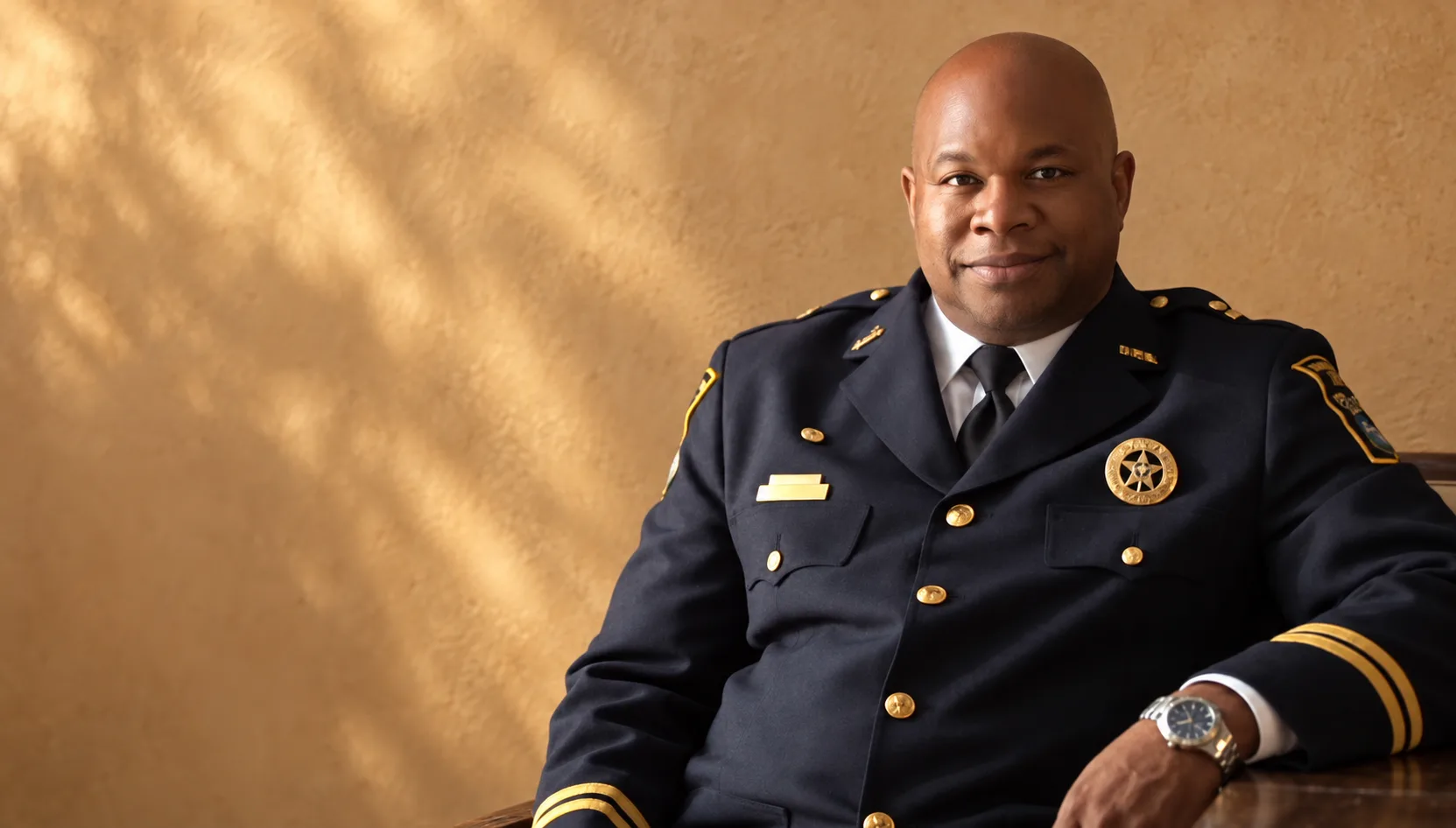
Chaplain Wesley McDuffie
Tarrant County Sheriff’s Office chaplain · Cross-cultural ministry
The Reverend Wesley McDuffie serves with the Tarrant County Sheriff’s Office in Fort Worth and has also served the Dalworthington Gardens Department of Public Safety, the Drug Enforcement Administration’s Dallas Field Division and the National Association of Police Organizations. Before chaplaincy, he worked in commercial-vehicle enforcement for the Texas Department of Public Safety and retired after a 27-year career with UPS.
At Tarrant County, McDuffie has led a force of roughly 300 volunteers serving officers, inmates and families. The American Jail Association named him its 2023 Civilian Employee of the Year, describing a trail in chaplaincy that had benefited thousands. He has also organized work that is easy to overlook but meaningful inside a jail, including an inmate Christmas choir supported by volunteer officer-conductors.
McDuffie speaks directly about the barrier race can create in crisis ministry. As a Black chaplain serving white families, he has left some encounters unsure whether anything he said was heard or accepted. Some families have asked whether someone else could be sent. He does not pretend those requests are neutral, but he also refuses to make his own injury the center of a family’s emergency.
Because chaplaincy often offers no immediate proof of its effect, a later word of thanks can matter deeply. One person eventually came back to tell McDuffie that his help had been appreciated. “I was just happy that they verified that I did touch their heart and was able to help them.” The message confirmed that the boundary he felt in the room had not prevented his care from reaching the family.
“There’s been times when someone came back and said, ‘Hey, just want you to know I really appreciate everything that you did for me.’ And that was a situation where I’m like, oh, thank you. I didn’t look back. I just — I was just happy that they verified that I did touch their heart and was able to help them in some way or another.”
In his Police Chaplain Project interview When Race Is a Barrier , McDuffie discusses racial rejection in crisis care, the discipline of keeping the family’s needs central, and the rare later acknowledgment that showed his ministry had crossed a boundary.
McDuffie’s public honors describe the scale of his service; the interview reveals its cost and character. He crossed barriers without pretending they were not there, kept the family’s need ahead of his own hurt, and sometimes received the rare gift of learning that compassion had reached the other side.