
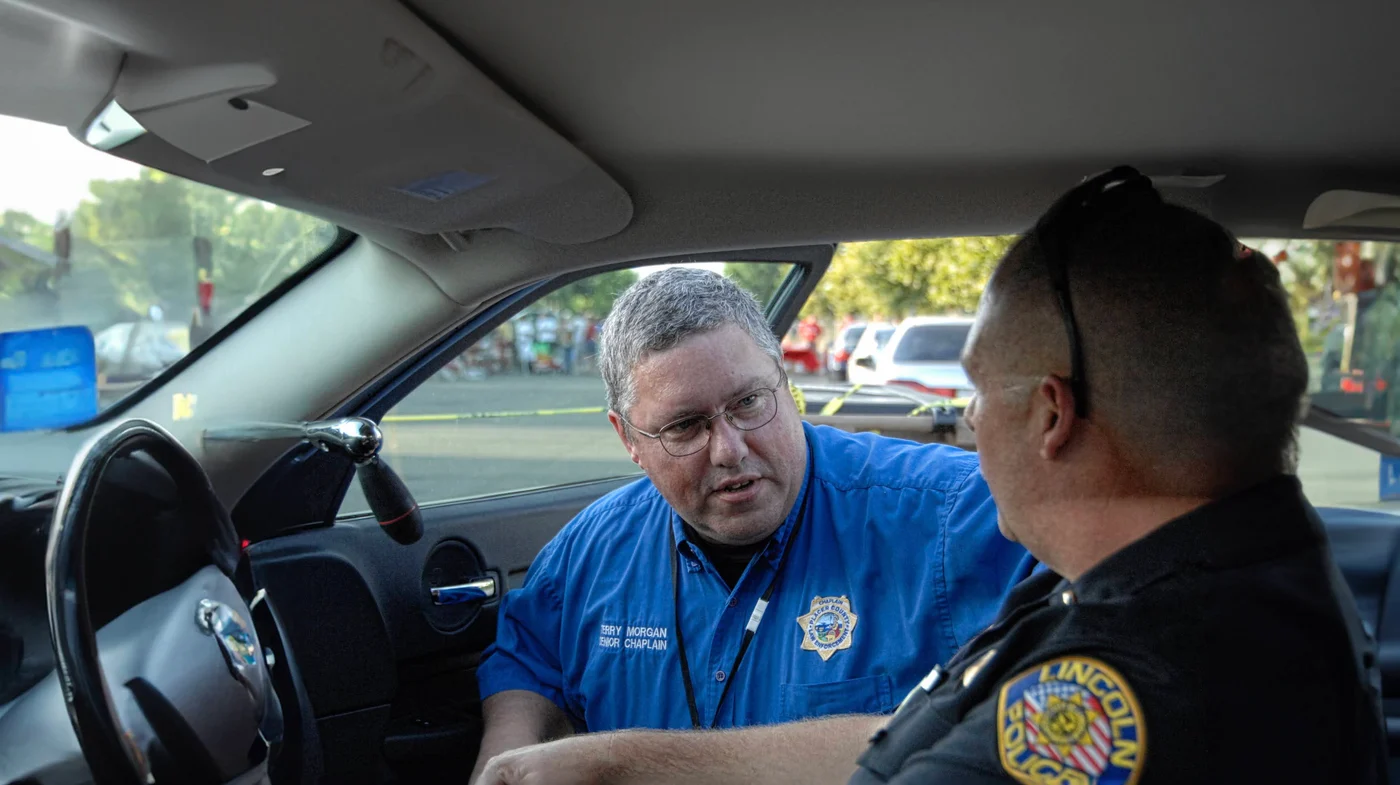
Chaplain Terry Morgan: The Science and Soul of Crisis Care
Senior chaplain, author, and educator
Chaplain Terry Morgan has spent more than forty years in ordained ministry and over twenty-five years as a law enforcement chaplain. Serving as Senior Chaplain and Executive Director of Gold Country Chaplaincy in California's Sierra Nevada foothills, he has dedicated his life to equipping chaplains and first responders with the tools needed to face critical incident stress, trauma, and moral injury.
Master Chaplain credentialed through the International Conference of Police Chaplains (ICPC) and a member of the International Critical Incident Stress Foundation (ICISF), Morgan bridges academic rigor with frontline crisis response. In addition to his law enforcement ministry, he serves as Senior Pastor of New Hope Church in Redding, California, works as a full-time hospice chaplain with Mercy Hospice / Dignity Health, and teaches crisis counseling at Shasta Bible College and Graduate School.
The Essentials of Public-Safety Chaplaincy
Morgan believes that effective chaplaincy requires rigorous preparation and deep personal discipline. He emphasizes five core principles that every chaplain must master: continuing professional training, patient trust-building, strict confidentiality, proactive self-care, and spiritual readiness.
"There are five essentials that every new chaplain should know before the first day on the job or volunteering in chaplain ministry. Number one is get training. There's no substitute for good training. Law enforcement officers are constantly training, and they're going to have a lot of respect for a person that's also continuing their training in chaplaincy and knowing what to do, what to say and how to do it."
He strongly cautions new chaplains against expecting immediate acceptance from officers, pointing out that trust is earned gradually through presence and strict confidentiality.
"Be patient and pay your dues. Just because you have a uniform and a title doesn't mean that you're going to be immediately accepted by all of the officers... When I get into a car for a ride-along, I always tell the officer: whatever's said in the patrol car stays in the patrol car. Keep secrets. This is probably one of the most important things as a chaplain that you can do... Once you lose their trust, it's really hard to ever get their trust again."
Spiritual and operational readiness must also align before responding to a crisis scene.
"Be prayed up before you go out. When you go to a crime scene or you're working with a law enforcement officer, you're not going to have time to pray... You need to be able to hit the ground running and be prepared for anything."
Frontline Crisis Response and Countertransference
Morgan’s ministry has called him to some of the country's most grueling disaster and trauma sites. He was among a small group of law enforcement chaplains chosen to embed with Louisiana Mental Health and the New Orleans Police Department immediately following Hurricane Katrina. He has also been selected to serve surviving family members of fallen officers during National Police Week in Washington, D.C.
Through hundreds of critical incident responses, Morgan has experienced firsthand the psychological weight that emergency calls place on first responders and chaplains, including the phenomenon of countertransference. He recalls responding to a tragic multiple homicide-suicide where a young boy was hospitalized with a gunshot wound to the head.
"I was assigned to be in the emergency room with the little boy as they're operating on his head... Part of my job was to be there with the child, make sure the child knew that he wasn't alone, but I was also there to keep an eye on the police officer and make sure he was okay... There's something called countertransference. As I was standing there, I'm looking at this little boy, and for just one second I thought, Gee, this little boy is about the same age and the same size as my little nephew. Kind of like the old black-and-white horror movies where you see Lon Chaney turning into a werewolf, this little boy's face changed right in front of my eyes. And he wasn't a stranger anymore—he was my little nephew. I had been taught about countertransference, but this was like getting kicked in the stomach... I left the house, went to this call, and a few hours later I was a different person. That was one call that changed me."
Critical Incident Stress Management and Verbalizing Trauma
To prevent cumulative trauma from developing into post-traumatic stress disorder (PTSD), Morgan advocates strongly for Critical Incident Stress Management (CISM) and structured debriefing.
"These kind of scenes sometimes can cause us not only mental problems, but physically they can make us sick... The key piece of Critical Incident Stress Management is being able to talk about what happened. When we have it bouncing around in our head, it has power over us. When we express it, it takes away some of the power of that scene... Having someone that can walk you through and ask the right questions—sometimes that's exactly what you need. It can be very healing."
In ministering to grieving families, Morgan helps individuals articulate their loss by putting a clear name on their grief:
"To lose a parent is like losing part of your past. To lose a spouse is like losing part of your present. To lose a child is like losing a part of your future."
Author, Educator, and Academic Legacy
Dr. Morgan holds a Doctor of Ministry in Spiritual Formation and Leadership and a Master of Divinity from Epic Bible College & Graduate School in Sacramento, as well as a Master’s degree in Ministry in Public Safety from Trinity Biblical University. He is Board Certified in Emergency Crisis Response by the American Academy of Experts in Traumatic Stress, a certified QPR Suicide Prevention trainer, and a provisional trainer for ASIST suicide intervention.
A prolific writer, his foundational textbook, The Chaplain's Role: How Clergy Can Work With Law Enforcement, was adopted by Liberty University for chaplain formation. His published works also include The Church Chaplain's Role, The Hospice Chaplain's Role, and What to Do When Grief Kidnaps Your Soul. In his writing, he articulates the noble heritage of public safety work through classical imagery:
"In my book The Chaplain's Role, I talk about how law enforcement officers are very similar to the Paladin Knights of old... A king would take a knight and give them a suit of armor with a shield, with the emblem of the king's symbol on the shield, a sidearm sword to enforce the laws, and a white steed to travel the countryside. It's very similar to our law enforcement officers, where they're given a badge to cover their heart with the symbol of the department, a firearm to enforce the laws, and their steed is a police car. It's a very noble calling."
Dr. Morgan lives in Redding, California, with his wife, Phyllis. Together they have two adult children and two grandchildren, grounding a lifetime dedicated to bringing resilience, faith, and clinical care to those who serve.