
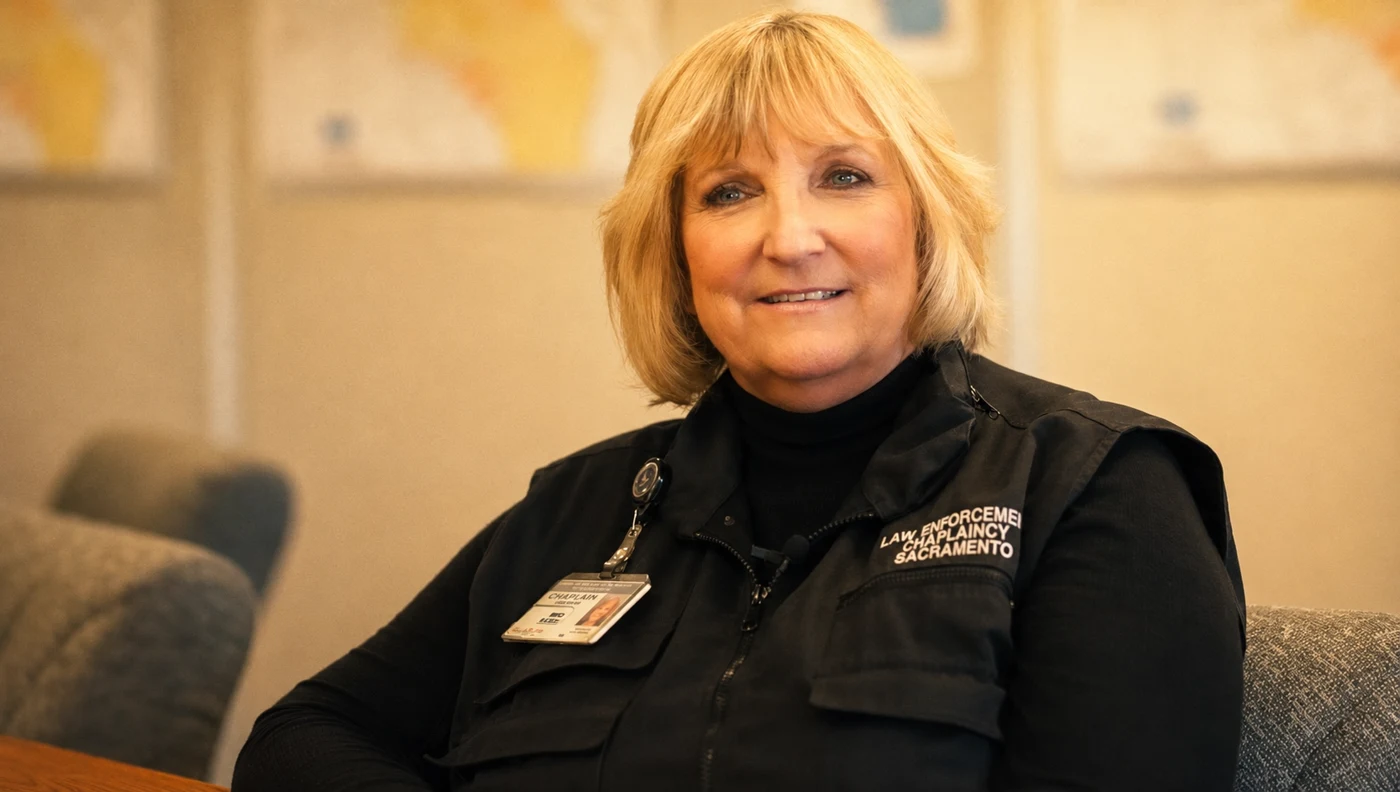
Chaplain Mindi Russell
Executive director · Law Enforcement Chaplaincy Sacramento
Mindi Russell began as the first female chaplain in Placer County and is believed to be one of the first female law-enforcement chaplains in the country. Since that time, she has established herself as an indispensable force for good, combining a deep intuition for helping others in crisis—born out of her own childhood—with an exceptional skill for organization. Together, these traits allowed her to build one of the nation's most widely admired chaplaincy organizations, serving as the gold standard that agencies and chaplains across the country actively look to emulate.
“Well, I was the first female chaplain in Placer County. Probably I was one of the first female chaplains in the nation. So the first day, I get sworn in had media, because quite frankly it was something new.”
Russell’s first major encounter with public trauma came in 1972, when she volunteered with the Red Cross at the Munich Olympics during the terrorist attack that killed eleven Israeli team members and a police officer. Three decades later, she served as a chaplain in New York for the first 16 days after September 11. Those experiences became part of the foundation for the around-the-clock crisis response she later led in Sacramento.
As executive director and chaplain of Law Enforcement Chaplaincy Sacramento, Russell has overseen rapid-response teams supporting law-enforcement agencies, schools, government offices, businesses and churches after trauma and loss. The U.S. Office for Victims of Crime honored her with its 2002 Crime Victim Service Award. Her public work has continued through mass-casualty responses, media interviews and September 11 memorial observances.
Her family adapted to the irregular life of a chaplain. Russell made herself available when officers were working, including Christmas Eve and Christmas Day. “We were there when they were there.” During one foggy Christmas Eve ride-along, a highly confident officer spent two quiet hours asking whether Jesus had really died on the cross for him. After the new year, he asked Russell to help him choose a Bible.
“So Christmas Eve — because I knew most of the other chaplains had church services, I was free. I was able to do Christmas Day and Christmas Eve, and my family understood that we were going to live a weird life, and we adapted. And um, so Christmas Eve, we’re driving around. It was very foggy. And I remember him saying things like, ‘I’m going to ask you some stupid questions. Don’t laugh.’ And it’s like, okay. ‘Did Jesus really die on the cross for me?’ It was just beautiful.”
In her Police Chaplain Project interview First Day as a Chaplain , Russell discusses breaking a gender barrier, the difference between collegial acceptance and institutional condescension, the credibility earned by sharing officers’ hours, and a Christmas Eve conversation that put the lesser difficulties she had faced in perspective.
Russell opened a door that had rarely admitted women, then spent her career making sure the door behind her stayed open. Awards marked the public reach of that work; its private meaning lived in foggy patrol cars, late-night calls and the officer sitting on the floor beside her, choosing a Bible.